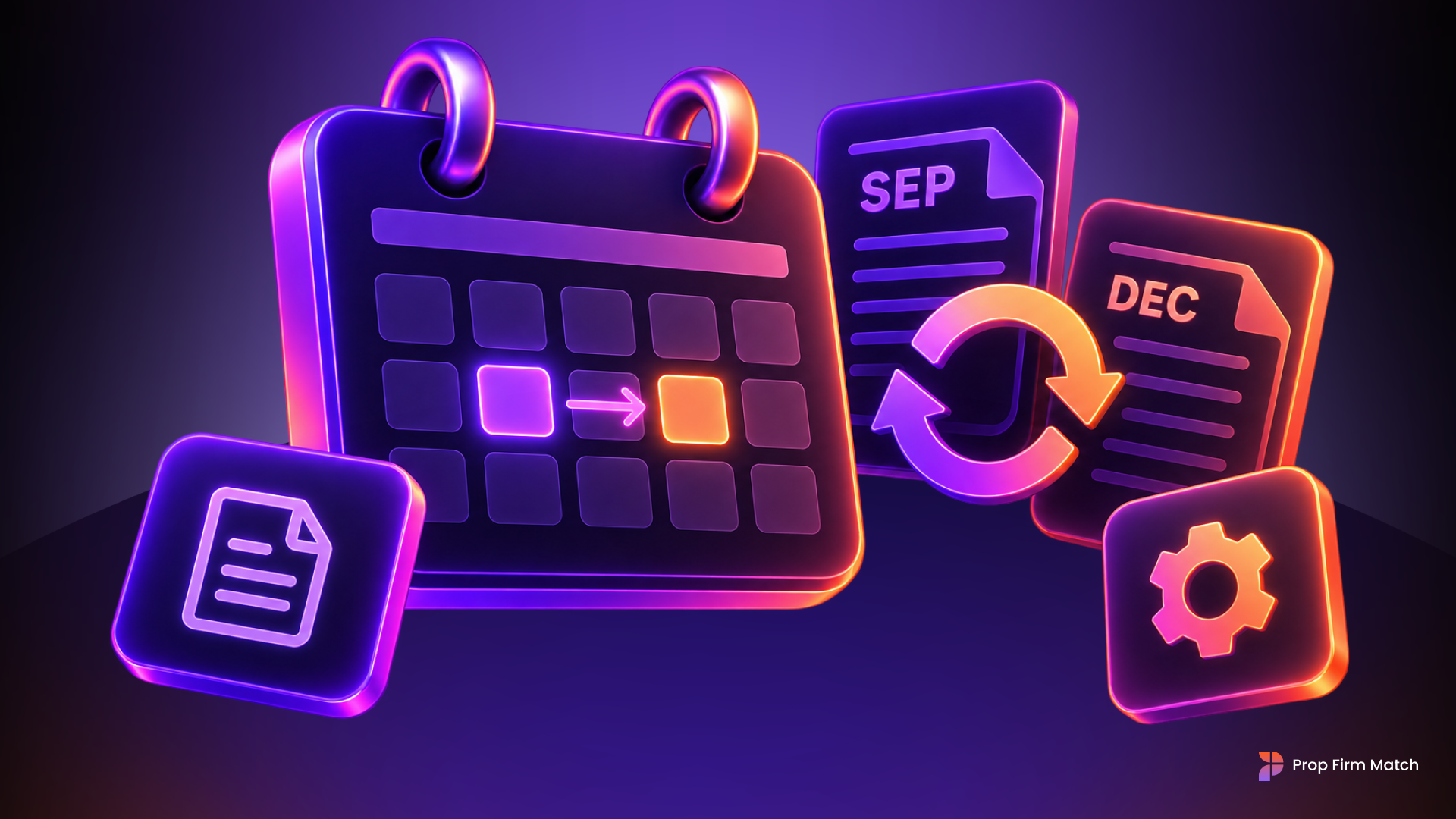
Futures rollover is one of those market mechanics that can seem minor until it affects an actual trade.
A trader can open the usual chart, place the usual order, and assume everything is still pointing at the same market as last week. During rollover, however, trading activity begins shifting into a later contract. The chart or workspace may update with it, while open positions, working orders, alerts, or automated strategies remain tied to the old contract.
For a funded prop trader, that creates another layer of risk.
Rollover can affect liquidity, fills, chart levels, order tickets, drawdown room, and firm rule compliance. Nothing unusual is happening to the market; futures contracts are simply moving through their normal expiry cycle. But the handover still needs to be managed properly.
This guide explains what futures rollover means, when traders commonly move from one contract to the next, why the process can create additional risk in funded accounts, and what prop traders need to pay attention to during roll week.
The September 2026 U.S. stock index rollover is used as the current example. Once that roll has passed, the process remains the same, but the relevant contract calendar, platform guidance, and firm rules will need to be checked for the next rollover.
A futures contract is an exchange-traded contract with an expiry date.
That expiry is what makes rollover necessary.
Unlike a stock, which can continue trading under the same ticker without an expiry date, futures markets are divided into contract months. An equity index future, for example, may have September, December, March, and later contracts listed at the same time.
They track the same underlying market, but they are not the same instrument.
Each contract has:
The front month is generally the nearest-expiry contract carrying most of the trading activity. When traders say they are trading ES, NQ, MES, or MNQ, they are usually referring to the active front-month contract.
The back month, or deferred month, is a later contract. As expiry approaches, trading activity begins moving from the outgoing contract into the next one.
That shift is the rollover.
For someone carrying an open position, rolling usually means closing the expiring contract and opening a similar position in a later month. Many funded prop traders are flat at the end of the session anyway, so their rollover may be simpler: switch the chart, order ticket, alerts, and strategy settings to the new active contract before the next trade.
Either way, the principle is the same:
The contract being traded should match the contract where the market's activity has moved.
Futures contracts are not permanent.
As expiry approaches, traders begin moving into a later contract month. The outgoing contract may continue trading, but activity usually falls as more participants switch away from it.
For U.S. stock index futures such as ES, NQ, MES, and MNQ, the main cycle is March, June, September, and December.
Index futures traders therefore encounter this process four times a year.
Other markets work differently. Crude oil has monthly contracts. Gold follows its own active-month structure. Nikkei and TOPIX equity index futures can also roll on different schedules from U.S. equity index products.
That is why one rollover date cannot be applied across every futures market.
The relevant window depends on the product, the exchange calendar, where trading activity has moved, how the platform handles contract changes, and any firm-specific requirements.
For the September 2026 U.S. stock index futures roll, CME lists:
| Date | What it means |
| Monday, 14 September 2026 | CME's customary roll date for U.S. equity index futures |
| Friday, 18 September 2026 | September U.S. index futures expiration |
Those dates do not mean every trader, platform, or prop firm switches contracts at exactly the same moment.
The roll date is better treated as the point when traders should start paying closer attention. The market confirms the handover as activity moves from the September contract into December.
If the September contract still carries more activity, the market may not have fully shifted. Once the December contract becomes more active, it is increasingly becoming the main trading contract.
The date tells traders when to start watching.
The activity tells them where trading has moved.
The outgoing and incoming contracts will not necessarily trade at the same price.
September and December E-mini S&P 500 futures, for example, may both follow the S&P 500 but still display different values.
That does not mean one of the contracts is wrong.
Each expires at a different point in time, so the price difference can reflect factors such as interest rates, dividends, and the cost of carrying exposure forward.
This is also why a continuous futures chart can show a gap or jump around rollover.
The underlying market may not have made that move at all. What the chart is showing could simply be the price difference between the two contract months being joined together.
For prop traders, the practical issue is chart levels.
A support level drawn on a back-adjusted continuous chart may not line up perfectly with the order book of the live contract. A stop copied directly from one contract month to another can also end up sitting somewhere different from where the trader intended.
Before trading the new contract, check the live chart and redraw any important levels against the contract that will actually receive the order.
Two numbers are particularly useful during rollover:
| Term | What it means | Why it matters |
| Volume | How many contracts traded during a period | Shows how active the contract was during that session |
| Open interest | How many contracts remain open and have not yet been closed | Shows how much positioning remains in that contract month |
Volume tells you how much trading took place.
Open interest tells you how many contracts are still open.
During roll week, the expiring contract and the next contract can be compared side by side. While the outgoing contract still carries more activity, many traders continue using it. Once the later contract overtakes it, that is one signal that liquidity has shifted.
CME education specifically describes watching volume in the expiring contract and the next contract when deciding when to roll. Open interest is also widely used by traders as an additional signal, but it is better treated as a market indicator than as a specific CME instruction.
The broader point is simply to not rely on the calendar alone. Watch where liquidity is moving.
The process can be kept relatively simple.
Start with the expiring contract and the next active contract.
For the September 2026 U.S. stock index roll, that means comparing September and December.
For example:
| Contract code | Meaning |
| ESU6 or ESU26 | September 2026 E-mini S&P 500 contract |
| ESZ6 or ESZ26 | December 2026 E-mini S&P 500 contract |
Symbol formatting varies between platforms. Some use one digit for the year, while others use two.
The important part is knowing which expiry month the symbol represents.
During roll week, look at the outgoing contract alongside the next one.
Volume is often the clearest measure of where the day's trading activity is concentrated. Open interest can add another view of how much positioning remains in each contract.
There is no need to spend the entire session watching another screen. A periodic check during the rollover window is usually enough to see the transition developing.
The crossover comes when the later contract becomes more active than the expiring one.
Volume and open interest may not switch at exactly the same time. The useful signal is the broader migration of activity into the new contract.
That is what traders are trying to identify.
Switching the chart is only part of the job.
Once the trader moves to the new contract, the same contract should be reflected across:
Knowing that liquidity has moved does not help if the order ticket is still pointed at the old contract.
Rollover affects all futures traders, but funded accounts add another constraint: the account is operating inside a fixed set of rules.
Those can include:
As activity leaves the expiring contract, liquidity can become thinner. That can mean wider spreads, less market depth, and a greater chance of receiving a worse fill than expected.
The difference between the expected fill and the actual fill is slippage.
Slippage can work in either direction. For a funded trader, the concern is unfavorable slippage because it directly affects account P&L.
If the account is already close to a daily loss or drawdown threshold, that extra execution cost reduces the remaining margin for error.
Rollover does not automatically create a breach.
It can simply make mistakes more expensive.
The problem with unfavorable slippage is not only the fill itself.
It consumes room inside the account's risk limits.
A trader may already be operating near a trailing drawdown level, daily loss limit, or funded-stage buffer. If the expiring contract has become thin and an order fills worse than expected, the account now has less space before a breach.
Intraday trailing drawdown structures can be especially sensitive.
In some prop firm accounts, the threshold rises as the account reaches new highs, including while profit is still unrealized. If the position then reverses and the eventual fill is worse than expected, the trader may have less remaining room than initially suggested.
End-of-day drawdown structures are not immune to poor fills. Slippage still affects P&L. What changes is how and when the failure threshold moves.
One assumption should remain constant: Rollover does not pause the account's drawdown rules.
A common rollover mistake is assuming the platform has taken care of everything.
It may have updated the chart.
It may have rolled the workspace.
A continuous symbol may already be displaying prices from the new front month.
None of that guarantees the rest of the trading setup moved with it.
Open positions, working orders, stop losses, profit targets, alerts, automated strategies, trade copiers, order templates, chart drawings, and DOM settings may still be associated with the old contract.
That creates an easy mismatch. The trader is analysing the new contract while an order or strategy remains attached to the expiring one.
During rollover, the order ticket deserves at least as much attention as the chart.
The contract shown there is the one the order will actually trade.
Continuous futures symbols make long-term charting easier by stitching several contract months together.
That is useful for historical context. It can also create confusion around rollover.
Because successive contract months do not always trade at the same price, the platform needs a method for connecting them. Some continuous charts show the price gap directly. Others back-adjust the historical series to make the transition look smoother.
That adjustment can move older price levels.
As a result, values taken from a continuous chart may not line up exactly with the live contract.
This becomes relevant when using:
The continuous chart is useful for context.
Execution still happens in an actual contract month.
Before an order is sent, the contract shown in the order ticket, DOM, or trading panel should match the one the trader intends to trade.
TradingView's continuous symbols are a useful example of why the trading panel matters.
TradingView allows trading from 1! continuous futures symbols for CME and EUREX futures. Its guidance says an order submitted from a 1! continuous contract is placed in the front contract, which is the nearest-expiry contract currently represented by that continuous symbol.
The actual contract can be seen in areas such as the Order Panel, DOM, and Buy/Sell buttons when instant order placement is enabled.
That creates an important distinction.
The chart symbol provides the continuous view. The order panel tells the trader which contract will actually receive the order.
Around rollover, those two pieces of information are easy to conflate.
Before trading from a continuous symbol, read the exact contract shown in the order panel.
There is no universal rollover process across futures prop firms and trading platforms.
The details depend on the setup.
In TopstepX, contracts are rolled automatically during the daily market-close window. The platform uses trading volume, open interest, and expiration dates as part of that process.
That does not mean every rollover task is handled for the trader. Alerts tied to the old contract are permanently deleted when the contract rolls, so traders need to recreate them on the new front-month contract.
Topstep also requires traders to be flat by its daily cutoff, or earlier if the product closes sooner.
The practical takeaway is simple: even when the contract roll is partly automated, traders still need to check alerts, flat-time rules, and the contract shown before placing the next trade.
For Apex traders, the key issue is avoiding expired contracts and making sure the correct NinjaTrader contract is selected before trading.
The research did not identify one single firm-wide Apex rollover deadline in the pages reviewed, so traders should not assume a universal Apex switch time.
NinjaTrader also requires extra attention from traders using automation. A workspace or contract update may not automatically update every NinjaScript strategy, so automated strategies should be checked manually during rollover.
The practical takeaway is that Apex traders should confirm the active contract, review the platform setup, and make sure any automation is pointed at the correct symbol before trading.
For Tradeify traders using Tradovate, automatic rollovers are enabled by default in the Tradovate Web App.
The important detail is that a platform rollover does not transfer an existing open position into another contract. The workspace can change while the position stays behind.
For Tradeify traders using WealthCharts, contracts with fixed expiries need to be changed manually in charts and in the DOM or order ladder. Continuous contracts such as ES1 may roll automatically, but traders should still check the tradable contract before sending an order.
The practical takeaway is that rollover can work differently even inside the same firm, depending on the platform. Traders should check the platform they actually use, not assume one rollover process applies everywhere.
Futures symbols use standardized month codes.
They are not simply the first letter of each month.
| Month | Code |
| January | F |
| February | G |
| March | H |
| April | J |
| May | K |
| June | M |
| July | N |
| August | Q |
| September | U |
| October | V |
| November | X |
| December | Z |
For example:
| Symbol | Meaning |
| ESU6 | September 2026 E-mini S&P 500 |
| ESZ6 | December 2026 E-mini S&P 500 |
| NQU6 | September 2026 E-mini Nasdaq-100 |
| NQZ6 | December 2026 E-mini Nasdaq-100 |
Platforms may display the year differently, such as ESZ6 or ESZ26.
The expiry month is the part that matters most during the rollover check.
The word "rolling" is used for several unrelated things in prop trading.
Rolling a futures contract is ordinary market maintenance. It means moving from an expiring contract month into a later one.
Rollover arbitrage is different. Some firms restrict or prohibit arbitrage-style strategies that attempt to exploit price differences between contracts, platforms, or feeds.
Account rolling is another separate concept. Depending on the firm, it may refer to an account process, subscription, reset, renewal, or another account-level action.
These terms should not be treated as interchangeable.
Moving from the outgoing futures contract into the active one is not the same as running a rollover-arbitrage strategy.
Where traders use calendar spreads, cross-contract strategies, automation, or copy trading, the firm's prohibited-conduct rules still deserve particular attention.
The final rollover check is best done against the trader's actual setup.
Confirm the contract month on the chart, DOM, and order ticket.
A continuous chart is not necessarily the same thing as the tradable contract.
Compare the outgoing contract with the next one to see where activity is concentrated.
Look at the spread and depth.
A thinner book can increase execution risk.
Make sure stops, targets, brackets, and resting limit orders are not still attached to the expiring contract.
Recreate alerts where the platform does not carry them into the new contract automatically.
Bots, NinjaScript strategies, trade copiers, and other automated tools need their own symbol check.
A chart rollover does not guarantee the automation followed it.
Recheck important levels against the contract being traded rather than relying only on a back-adjusted continuous chart.
Look at the rules that could affect the account during the handover, including flat times, position limits, drawdown, news policies, consistency requirements, and prohibited strategies.
Know whether the platform rolls charts, workspaces, alerts, or contracts automatically, and what it leaves untouched.
Some traders choose to reduce size while liquidity is moving between contracts.
That is a risk-management decision, not a universal rollover rule.
Most rollover problems come from a relatively small group of mistakes:
Most of these have the same root cause:
Something was assumed to have moved automatically when it had not.
There is no single answer for every futures product, firm, or platform.
For most traders, the process is more useful than the date.
Start watching during the exchange's published rollover window. Then compare the expiring and next contracts using volume, open interest, bid/ask quality, platform guidance, and any firm-specific requirements.
For U.S. stock index futures, CME's roll date is a useful reminder. The trading decision itself depends more on where liquidity has actually moved.
If the outgoing contract remains more active, there may be no reason to rush the switch. Once the later contract clearly becomes the more liquid market, the case for moving becomes stronger.
Funded traders do not need to identify the exact minute of the crossover.
They do need to avoid sending an order to the wrong contract.
Useful reference points include:
Holding too close to expiration can introduce complications that most funded traders have little reason to take on.
Some futures contracts are cash-settled. Others involve physical delivery mechanics. Prop firm accounts may also impose flat-time or position rules that require traders to exit long before those mechanics become relevant.
Even with cash-settled index futures, staying in the contract through settlement means accepting a settlement process rather than choosing the exit in the normal market.
For most prop traders, the practical objective is simpler: move before the expiring contract becomes difficult to trade and while both contract months still have usable liquidity.
A few extra ticks rarely justify turning a routine rollover into an avoidable account-management problem.
Because rollover procedures differ, the useful questions are firm- and platform-specific:
If the FAQs or help centre does not answer a question, the firm's support channel is the better place to resolve it before a trade is sent.
Silence in the rules should not be treated as automatic permission.
Rollover is another reason to compare futures firms on more than account price or nominal size.
Prop Firm Match's futures section lets traders research futures-focused firms, open individual firm pages, read trader feedback and reviews, and compare areas such as platforms, brokers, countries, account structures, payout methods, and available features.
That can help narrow the field to firms and platforms that already fit the trader's workflow.
Rollover itself is more specific.
The exact process can depend on the platform, the contract, and the firm's current guidance. Once a trader has chosen a firm, the final rollover check belongs inside that firm's documentation and the actual trading platform.
Futures rollover means moving from an expiring futures contract into a later contract month. It happens because futures contracts expire and trading activity eventually shifts into a newer contract.
As a contract approaches expiry, liquidity typically moves into a later month. Traders who want to continue trading the same underlying market then move to the contract carrying the newer activity.
For September 2026 U.S. equity index futures, CME lists Monday, 14 September 2026 as the customary roll date and Friday, 18 September 2026 as expiration.
The roll date is best treated as a reminder to monitor the transition rather than a universal switch time for every firm or platform.
The calendar provides the window. Market activity helps show when the handover is actually happening.
Volume is commonly compared between the expiring contract and the next month, with open interest providing additional context.
The front month is generally the nearest-expiry contract carrying most of the market's trading activity.
During rollover, the next contract can become the new front month as activity moves into it.
Open interest is the number of futures contracts still open and not yet closed or offset.
It differs from volume, which measures how many contracts traded during a particular period.
Rollover can increase execution risk if liquidity becomes thinner in the contract being traded.
The effect varies by product and session, so traders should not assume a fixed amount of slippage.
No. Drawdown, daily loss, flat-time, position-limit, and prohibited-strategy rules should be assumed to remain in force unless the firm explicitly states otherwise.
Not necessarily.
A platform may update a chart or workspace without moving positions, orders, alerts, or automated strategies. The platform's own rollover guidance determines what happens.
Some platforms allow orders to be placed from certain continuous futures symbols.
Where that is supported, the order panel, DOM, or ticket should still be used to confirm the actual contract receiving the order.
No. Moving from an expiring contract into the later active contract is normal futures rollover. Rollover arbitrage is a separate strategy category that some firms may restrict.
The most important areas are the contract month, order ticket, current liquidity, working orders, alerts, automated strategies, chart levels, platform behavior, firm rules, and remaining drawdown room.
Keep Reading
Perpetual futures, also known as perps, are derivative contracts that let traders go long or short without a scheduled expiry date. This guide explains what perpetual futures are, how crypto perps work, funding rates, leverage, liquidation, and the key differences between perpetual futures, traditional futures, spot trading, and crypto CFDs, including how perps are being used in prop trading.
Oct 5, 2026 • 20 min read
Best Futures Prop Firms to Compare in 2026
Futures prop traders have more firms, platforms, account types, and payout structures to compare than ever before. This guide compares eight futures prop firms that appeared across multiple Prop Firm Match signals, helping traders evaluate each firm by structure, rules, drawdown type, contract limits, platforms, payouts, and trader activity before choosing an evaluation.
Aug 17, 2026 • 17 min read
Funded Accounts for Swing Trading: Pros, Cons, and Key Rules to Check
Swing trading can work inside a funded account, but only when the firm’s rules support the trader’s holding period, risk model, and trade frequency. This guide explains the pros and cons of funded swing trading, including overnight and weekend holding, drawdown calculations, news risk, swap fees, minimum trading days, payout conditions, and what traders should check before buying an evaluation.
Aug 17, 2026 • 12 min read

Reviews & Rankings
News & Insights
Tools & Resources
Programs & Rewards
200 Loyalty Points Welcome Bonus.
Sign up free to claim points, unlock rewards, save favorite firms, and start earning more through reviews and platform activity.