Best Funded Trader Programs: Explicit Comparison of Instant, 1-Step, and 2-Step Challenges

Best Funded Trader Programs: Explicit Comparison of Instant, 1-Step, and 2-Step Challenges

March 20th, 2025
Prop Firm Reviews & Comparisons

Introduction

The prop firm industry has grown significantly, giving traders more ways to get funded. Choosing the right firm comes down to factors like the challenge type, drawdown rules, profit splits, scaling options, and special features. This article breaks down Instant funding, 1-Step, and 2-Step challenges, covering their pros, cons, and what makes each one unique.

1. Understanding Challenge Types

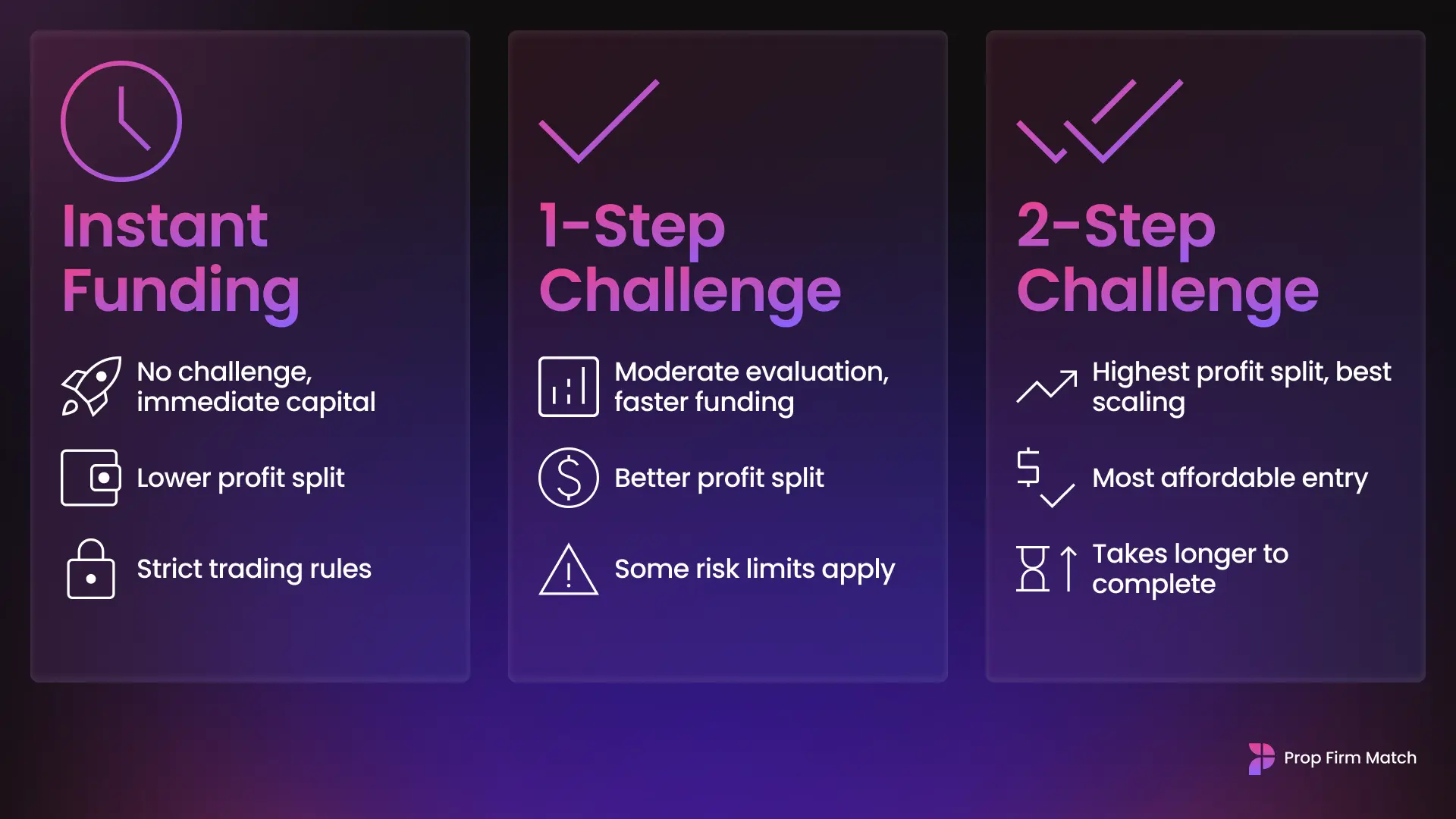
Instant Funding

  • Model: You get a funded account immediately after purchase.
  • Evaluation: No challenge or verification required.
  • Profit Split: Usually lower because the firm takes higher risks.
  • Risk Management: Very strict rules; too aggressive trading may get your account closed.

1-Step Challenge

  • Model: Traders must complete one evaluation phase before receiving a funded account.
  • Evaluation: Profit target with drawdown limits and trading requirements.
  • Profit Split: Often higher than instant funding but lower than 2-step models.
  • Risk Management: More flexible than instant funding but still requires discipline.

2-Step Challenge

  • Model: Traders complete two evaluation phases before funding.
  • Evaluation: Usually involves hitting a profit target in both phases while respecting drawdown rules.
  • Profit Split: Highest among all models.
  • Risk Management: More flexible than instant funding and 1-step challenges because traders have two phases to prove consistency, allowing for a more balanced approach to risk and strategy adjustments.

2. Explicit Comparison of Funded Challenges

FeatureInstant Funding1-Step Challenge2-Step Challenge
Time to FundingImmediateAfter passing 1 stepAfter passing 2 steps
Profit SplitLower (e.g., 50–75%)Medium (e.g., 75–85%)Higher (e.g., 80–90%)
Risk ToleranceStrictModerateMore flexible
Challenge PhasesNone12
Scaling PlanAvailableAvailableAvailable
Drawdown TypeStatic/TrailingStatic/TrailingStatic/Trailing
CostHighest upfrontMediumLower initial fee

3. Pros & Cons of Each Model

🔓 Instant Funding

✅ Pros❌ Cons
No challenge or evaluation phase.Expensive upfront cost.
Capital is available right away.Lower profit split.
Experienced traders don’t waste time on evaluation.Strict trading rules & limited risk flexibility.

✅ 1-Step Challenge

✅ Pros❌ Cons
Faster than 2-step funding.Still requires evaluation.
Moderate profit split and cost.Risk management is key.
Good balance between challenge and instant funding.Stricter risk limits compared to 2-step challenges.

🏁 2-Step Challenge

✅ Pros❌ Cons
High profit split.Longest time to funding.
Lower price compared to 1-step and instant funding.Requires consistency over two phases.
More capital scaling opportunities.More time-consuming.

4. Special Features to Consider

Scaling Plans

  • Some firms allow traders to increase capital after reaching certain profit milestones.
  • When scaling criteria are met, the account size and profit split are usually increased.

Drawdown Types

  • Static Drawdown: A fixed loss limit that does not change. Mostly used for 2 step accounts.
  • Trailing Drawdown: Moves with profits and can lock in at certain levels (more difficult).Usually used for 1-Step and Instant accounts.

Other Unique Firm Features

Prop firms offer unique features to attract traders and enhance their experience. Here are some key ones:

  • Bi-Weekly Payouts: Some firms offer quicker withdrawals on a bi-weekly basis
  • No Time Limits: Complete the evaluation phase at your own pace without pressure or stress.
  • Weekend Holding & News Trading: Allows trading during high-impact news and holding positions over weekends (ideal for swing traders ).
  • Balance-based Daily Drawdown: Uses end-of-day balance for drawdown instead of real-time equity fluctuations, offering more flexibility.
  • Scaling Plans: Firms increase account size for consistent profits, rewarding disciplined traders .
  • Trade Copying: Some firms allow copying trades across multiple funded accounts useful for diversifying risk.
  • Instant Withdrawals: Some firms offer same-day payouts via crypto or fintech solutions (e.g. Rise,Wise), avoiding long processing times.
  • Challenge Reset Options: Discounted reattempts if you fail due to drawdown violations instead of repurchasing a new challenge at the full price.
  • Fee Refunds: Most firms refund the evaluation fee after passing the challenge, reducing financial risk.
  • Drawdown Blocker: A Drawdown Blocker is a tool for risk management used by the prop trading firm to support the trader in adherence to their limits of risk. It does that by observing daily losses and avoiding overtrading, monitoring the continuous drawdowns. Once the trader reaches a limit, the system goes on to auto-turn the trading off, covering all open positions and pending orders. This halt, however, is only for the day as traders are allowed to resume the next day. This feature prevents the trader from over-trading beyond his drawdown maximum, a cause of account and firm capital loss. It is often set per the firm's risk policies or the trader's risk tolerance.
  • Auto-Close on Profit Target: Automatically closes trades once the profit target is reached, so you lock in your gains and pass the challenge without risking extra losses.

Conclusion: Which Model Is Best for You?

If you need immediate access to funds, the Instant Funding option is the best choice. For those seeking a fast yet reasonably challenging evaluation, the 1-Step Challenge offers a streamlined path. However, if your goal is to maximize your profit split while benefiting from a solid scaling plan, the 2-Step Challenge is the ideal route.

Each model is designed for a specific trader, so choose the one that suits your trading style, risk and capital. Review firm specific conditions before committing.

learn prop trading,trading platform,trading tips,prop trading basics,trading insights,prop firm education
Comments0
Sort by

Keep Reading

Futures Rollover Explained: When to Roll Contracts and What Prop Traders Should Check
Prop Firm Education

Futures Rollover Explained: When to Roll Contracts and What Prop Traders Should Check

Futures rollover can affect liquidity, slippage, chart levels, drawdown room, and prop firm rule compliance. This guide explains when to roll futures contracts, how to track volume and open interest, and what funded traders should check before moving to the next active contract.

Sep 14, 2026 • 23 min read
Best Futures Prop Firms to Compare in 2026
Prop Firm Reviews & Comparisons

Best Futures Prop Firms to Compare in 2026

Futures prop traders have more firms, platforms, account types, and payout structures to compare than ever before. This guide compares eight futures prop firms that appeared across multiple Prop Firm Match signals, helping traders evaluate each firm by structure, rules, drawdown type, contract limits, platforms, payouts, and trader activity before choosing an evaluation.

Aug 17, 2026 • 17 min read

Funded Accounts for Swing Trading: Pros, Cons, and Key Rules to Check
Prop Firm Education

Funded Accounts for Swing Trading: Pros, Cons, and Key Rules to Check

Swing trading can work inside a funded account, but only when the firm’s rules support the trader’s holding period, risk model, and trade frequency. This guide explains the pros and cons of funded swing trading, including overnight and weekend holding, drawdown calculations, news risk, swap fees, minimum trading days, payout conditions, and what traders should check before buying an evaluation.

Aug 17, 2026 • 12 min read

Stay Connected

Subscribe For The Latest In Prop Trading News And Deals