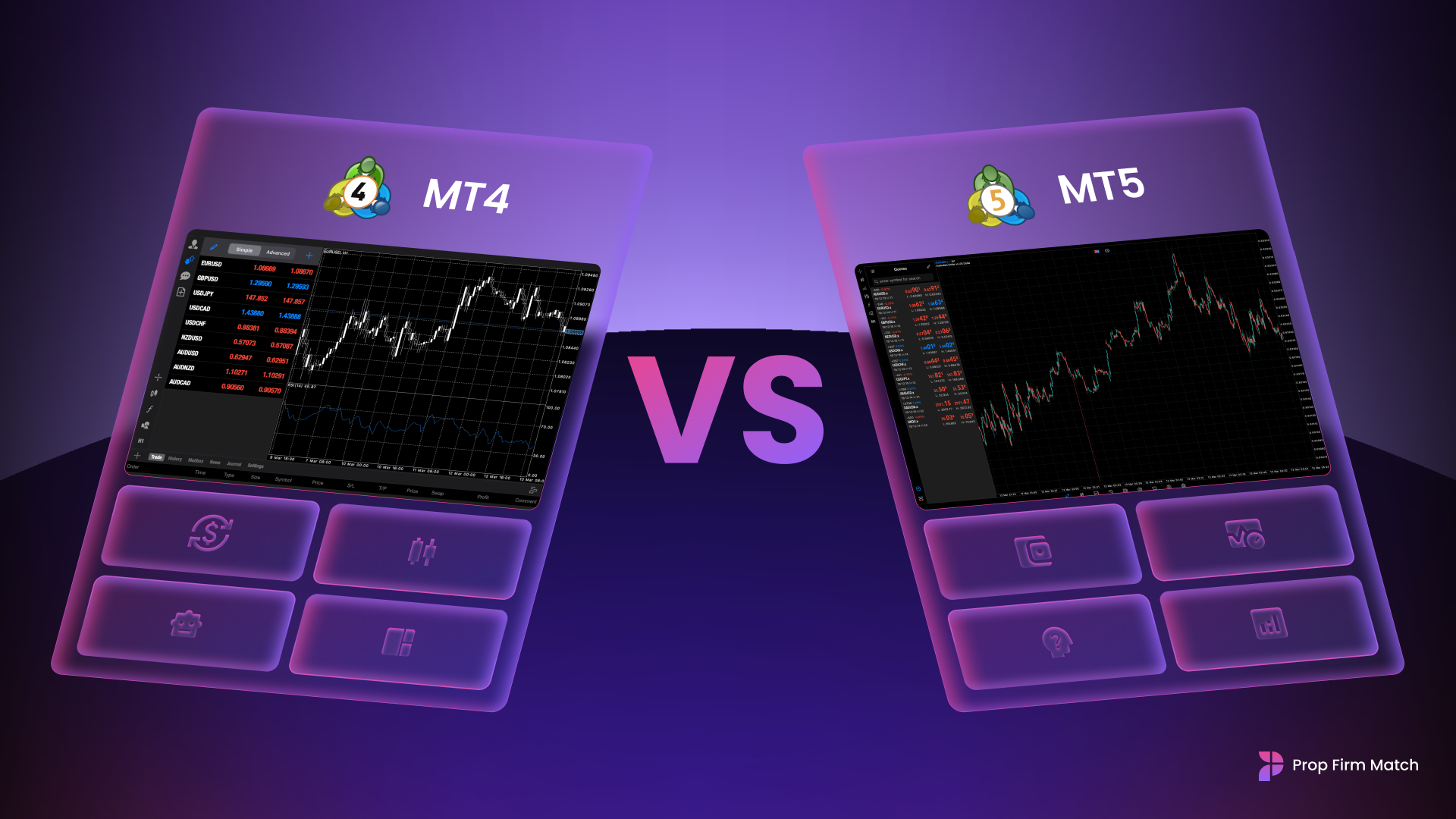
You are about to buy a prop firm challenge. You have seen both MT4 and MT5 in the platform options, and now you are wondering which one to choose.
It is a fair thing to pause on. In funded trading, your platform choice is usually locked in when you purchase the account. That makes it one decision worth getting right before you pay an evaluation fee, not after.
Here is the short version: MT5 is the more capable platform on almost every measure, and it is also where much of the prop industry has moved. But MT4 still has one genuine advantage that matters for a specific type of trader.
This guide breaks down the real differences between MT4 and MT5, what they mean specifically for funded accounts, and how platform availability across prop firms should factor into your decision.
Both platforms are built by MetaQuotes, and both are widely used across retail and prop trading. But they are not simply an “old version” and “new version” of the same platform.
MetaTrader 4 was released in 2005 and was designed specifically for forex trading. It became an industry standard thanks to its simplicity, and large library of custom indicators and Expert Advisors built in the MQL4 language.
MetaTrader 5 was released in 2010. It’s a multi-asset platform built for forex, stocks, futures, and exchange-traded instruments. It runs on the newer MQL5 programming language and is where MetaQuotes has focused much of its development for years.
That last point matters more than many comparisons admit. MT5 is not just newer. It is the platform MetaQuotes has continued to build around, while MT4 is largely in maintenance mode.
Here is how the two platforms compare on the features that matter:
| Feature | MT4 | MT5 |
| Timeframes | 9 | 21 |
| Built-in indicators | 30 | 38 |
| Graphical objects | 31 | 44 |
| Pending order types | 4 | 6 |
| Depth of Market | No | Yes |
| Economic calendar | No | Built-in |
| Strategy tester | Single-threaded | Multi-threaded, multi-currency, real ticks |
| Order accounting | Hedging | Hedging and netting |
| Markets | Forex | Forex, futures, options, stocks, bonds |
| Symbols | 1,024 | Unlimited |
A table only tells you so much, though. The more important question is what these differences actually mean when you are trading a funded account.
MT5’s 21 timeframes give traders more flexibility than MT4’s 9.
If your strategy relies on non-standard timeframes, such as 2-hour, 8-hour, or 10-minute charts, MT5 supports them natively. MT4 usually requires workarounds. Combined with more indicators and drawing tools, MT5 is the stronger analysis environment.
For traders who only use standard timeframes and simple charting, MT4 can still be enough. But if you want more built-in flexibility, MT5 has the clear advantage.
Backtesting is one of the biggest practical gaps between the two platforms.
MT5’s strategy tester is multi-threaded, supports multi-currency testing, and can use real tick data. MT4’s tester is single-threaded and more limited.
This matters in funded trading because evaluation fees are real money. The better you can validate a strategy before buying a challenge, the less likely you are to spend money on failed attempts.
Traders who backtest seriously will feel MT4’s limitations much faster than traders who only trade manually.
This is where the comparison becomes more nuanced, and where MT4 keeps its strongest argument.
MT4’s MQL4 ecosystem is enormous. Nearly two decades of custom indicators and Expert Advisors exist for the platform, and many older tools were never ported to MT5.
Importantly, MQL4 programs do not run on MT5. If your strategy depends on a specific legacy MT4 EA or custom indicator, that alone may decide your platform choice.
There is one caution: platform support and firm rules are separate questions. Even if MT4 supports your EA, your prop firm may not allow EAs or certain types of semi-automated trading. Always check the firm’s rules before building your platform decision around an EA.
MT5 adds two extra pending order types: buy stop limit and sell stop limit. It also supports Depth of Market.
For most discretionary traders, this is useful rather than essential. But traders who care about order flow, more precise order placement, or broader execution tools will usually prefer MT5.
MT4 is still simple and familiar, but MT5 gives traders more options.
You can compare MT4 and MT5 features all day, but in funded trading, you can only use what your prop firm offers.
That changes the conversation.
At the time of writing, only 8 prop firms listed on Prop Firm Match offer MT4, including FTMO, FundedNext, and Hola Prime. The list of firms offering MT5 is significantly longer, and for many firms, MT5 is the default MetaTrader option.
That is not an accident. MetaQuotes has focused development on MT5 for years, and many brokers and prop firms have followed.
In practice, this means MT4 narrows your choice. If you insist on MT4, you are choosing from a smaller pool of firms. If you are comfortable with MT5, far more of the market becomes available.
Traders comparing platform availability can use Prop Firm Match to compare prop firms that offer MT4 and prop firms that offer MT5.
Be honest about which of these descriptions fits you.
MT5 is likely the better choice if you:
MT4 may still make sense if you:
The difference is clear: most reasons to choose MT4 are about your existing setup, not the platform being better.
MT4 wins on familiarity and legacy tools. MT5 wins on features, flexibility, backtesting, and prop firm availability.
One more thing that matters is that the middle of an evaluation is the worst time to learn a new platform. If you are switching from MT4 to MT5, spend time on a demo or free trial account first. Misclicking an order type while a daily loss limit is active is an expensive way to learn the interface.
Platform matters, but it should not be the first filter.
A sensible order of comparison looks like this:
A firm with MT4 support is not automatically the right firm. A firm with MT5 support is not automatically better either.
The right choice is the firm and platform combination that fits how you actually trade.
You can compare platforms, rules, and pricing side by side using the prop firm challenge comparison on Prop Firm Match.
For most funded traders, yes. MT5 offers more timeframes, more indicators, better backtesting, more order types, and broader prop firm availability. MT4’s main remaining advantage is its legacy library of MQL4 EAs and indicators.
No. MQL4 and MQL5 are different programming languages, so MT4 EAs and custom indicators must be rewritten or replaced to run on MT5. If your strategy depends on a specific MT4 tool, check whether an MT5 version exists before choosing a platform.
Some do, but the number is smaller than MT5. At the time of writing, 8 firms listed on Prop Firm Match offer MT4, while MT5 is available across a much larger share of the industry. Always check the live platform lists, as availability can change.
Usually not. Platform choice is normally fixed when you purchase an evaluation, and accounts are tied to the firm’s infrastructure. If you want to switch, you would typically need to complete or abandon the current account and start a new one.
MetaQuotes has not announced a shutdown date, and existing MT4 servers continue to run. However, development focus moved to MT5 long ago, and fewer brokers and prop firms offer MT4 to new users. Building a long-term funded trading setup around MT4 carries some platform-availability risk.
MT5 is the stronger platform for most funded traders. It offers more timeframes, better backtesting, more order types, broader market support, and wider availability across prop firms.
MT4 still has a place, but mainly for traders who already depend on legacy MQL4 tools or prefer the platform because of long-term familiarity.
The best platform is not just the one with the most features. It is the one that fits your strategy, your tools, your chosen prop firm, and the rules you need to trade within.
For most new funded traders, MT5 is the better long-term choice. For traders with a specific MT4-based setup, MT4 can still make sense, but only if the firm’s rules and account structure also fit.
Keep Reading

Perpetual futures, also known as perps, are derivative contracts that let traders go long or short without a scheduled expiry date. This guide explains what perpetual futures are, how crypto perps work, funding rates, leverage, liquidation, and the key differences between perpetual futures, traditional futures, spot trading, and crypto CFDs, including how perps are being used in prop trading.
Oct 5, 2026 • 20 min read

Futures Rollover Explained: When to Roll Contracts and What Prop Traders Should Check
Futures rollover can affect liquidity, slippage, chart levels, drawdown room, and prop firm rule compliance. This guide explains when to roll futures contracts, how to track volume and open interest, and what funded traders should check before moving to the next active contract.
Sep 14, 2026 • 23 min read
Best Futures Prop Firms to Compare in 2026
Futures prop traders have more firms, platforms, account types, and payout structures to compare than ever before. This guide compares eight futures prop firms that appeared across multiple Prop Firm Match signals, helping traders evaluate each firm by structure, rules, drawdown type, contract limits, platforms, payouts, and trader activity before choosing an evaluation.
Aug 17, 2026 • 17 min read

Reviews & Rankings
News & Insights
Tools & Resources
Programs & Rewards
200 Loyalty Points Welcome Bonus.
Sign up free to claim points, unlock rewards, save favorite firms, and start earning more through reviews and platform activity.