
Not every trader starts with significant capital. For many, the priority is finding a funded trading program that offers a meaningful opportunity without requiring a large upfront commitment.
But “small budget” does not simply mean “cheapest price.”
The real question is capital efficiency:
How much opportunity are you getting relative to the risk you’re taking?
This guide breaks down how to evaluate funded trading programs when budget matters by focusing on structure, drawdown mechanics, payout conditions, and long-term sustainability rather than headline account size alone.
A small-budget program typically refers to evaluations or instant funding models with lower entry fees and smaller account allocations.
Common characteristics include:
However, the percentage-based risk rules are often similar across account sizes. A 10% maximum drawdown on a smaller account still requires disciplined risk management. The dollar value changes, but the structure does not.
This is why evaluating affordability requires more than just comparing prices.
Rather than focusing solely on cost, traders should consider how efficiently capital can be deployed.
Key questions include:
For example, a lower-fee program with a tight trailing drawdown may be more restrictive than a slightly higher-priced evaluation with a static drawdown. The cheaper option is not always the more sustainable one.
Capital efficiency balances cost, risk, and long-term opportunity.
Small-budget traders often gravitate toward specific program structures.
These models require traders to reach profit targets while respecting drawdown rules. They are typically more affordable than instant funding programs and may provide static drawdowns.
They can be a practical entry point for traders who prefer structured progression.
Instant funding removes evaluation phases but usually comes with higher fees and trailing drawdowns. While faster to access, these models can be less forgiving for conservative traders.
If you’re exploring instant options, you can compare Instant funding challenges here.
Many firms offer entry-level tiers designed for traders who want to test structure before committing to larger capital allocations. These programs often mirror the same rule framework as higher tiers, making them suitable learning environments.
Affordability can create psychological pressure. Traders trying to “make the most” of a lower-cost account often fall into avoidable traps.
Common mistakes include:
A smaller budget should encourage discipline, not urgency.
Programs designed for lower entry costs still reward consistency and rule adherence more than aggressive growth.
A program is truly affordable when:
Sometimes a slightly higher upfront fee provides more flexibility, making it the more cost-efficient option over time.
Budget trading is not about minimizing cost, but about maximizing sustainability.
When reviewing options, look at:
On Prop Firm Match, traders can compare:
Because best-selling challenges and most-favorited firms change over time, reviewing current rankings can also help identify which programs traders are actively choosing.
Funded programs designed for smaller budgets may be suitable for:
They may be less suitable for traders seeking unrestricted flexibility or high-risk leverage models.
Not necessarily. Risk depends more on drawdown structure and trading behavior than on price. Most of the time, the drawdown parameters are the same when compared to bigger account sizes.
Yes. Many firms offer scaling plans that increase allocation after consistent performance. The progression requirements vary, so reviewing scaling terms is important before starting.
Not always. Most entry-level programs offer the same or similar profit splits to larger tiers, with the same payout times and the same payout structures.
Smaller accounts can reduce financial stress because the upfront fee is lower. However, traders should still choose a program that aligns with their strategy rather than defaulting to the lowest cost option.
A small budget does not mean small opportunity.
It means choosing structure carefully, managing risk deliberately, and focusing on capital efficiency rather than headline account size.
The best funded program for a smaller budget is not necessarily the cheapest one, but rather the one that offers sustainable growth under realistic risk parameters.
If you’re evaluating your options, compare rule structures, drawdowns, payout timelines, and verified trader feedback before committing to any evaluation fee.
Crypto-Native vs. Crypto-Enabled Prop Firms: What the Difference Actually Means
Crypto-native prop firms are built around crypto trading, often featuring exchange-linked pricing, 24/7 trading structures, and stablecoin payouts. Crypto-enabled prop firms typically add crypto instruments to existing forex or CFD programs, where trading platforms, drawdown rules, and restrictions may differ. This guide compares their execution models, trading hours, crypto asset coverage, payout methods, and risk rules to help traders understand the differences and choose a crypto prop firm that suits their trading strategy.
Nov 9, 2026 • 7 min read
Futures Prop Firm vs Forex Prop Firm: Which Should You Choose?
Futures prop firms generally suit traders who focus on futures contracts and contract-based position sizing, while forex prop firms may be more familiar to traders using currency pairs, CFDs, and lot-based trading. This guide compares futures and forex prop firms across trading instruments, platforms, drawdown rules, evaluation costs, payout conditions, and country availability. Learn the key differences, which model may suit beginners, day traders, and swing traders, and what to consider before choosing a funded trading program.
Nov 2, 2026 • 19 min read
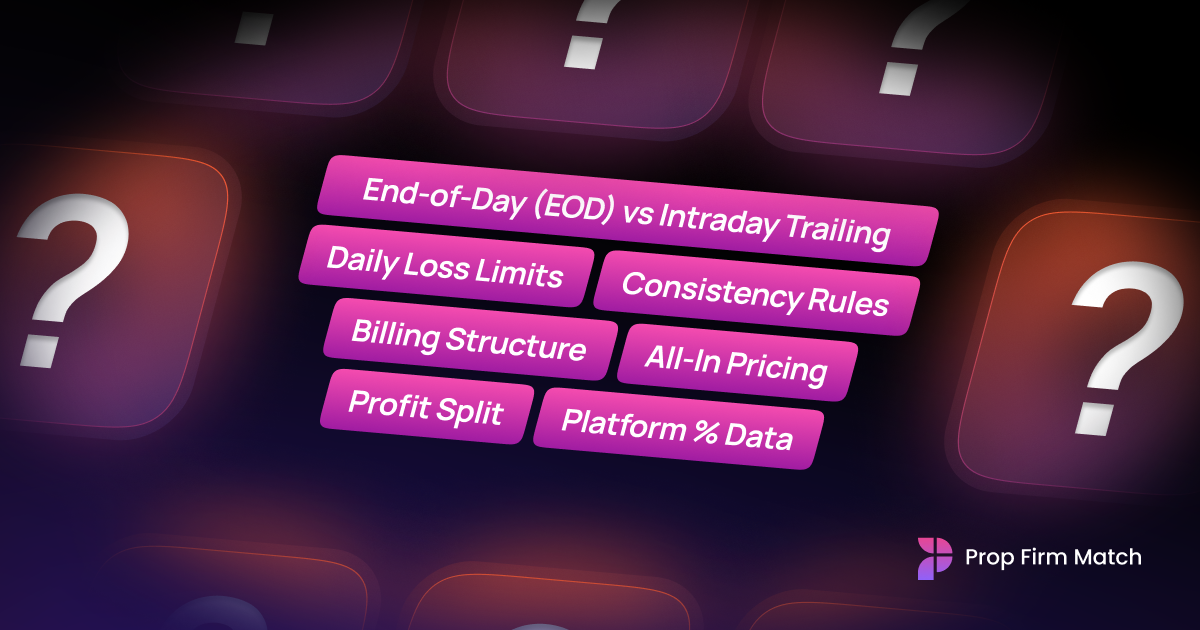
How to Choose a Futures Prop Firm in 2026: Step-by-Step Framework
To choose a futures prop firm, start with your trading style and risk requirements rather than price or account size. This 2026 guide provides a 14-step framework for comparing futures prop firms, covering drawdown types, daily loss limits, contract limits, payout conditions, trading platforms, account costs, and trader reviews. Learn how to use Prop Firm Match filters and comparison tools to shortlist suitable firms, compare their rules side by side, and make a more informed decision before purchasing an evaluation.
Oct 26, 2026 • 15 min read

Reviews & Rankings
News & Insights
Programs & Rewards
200 Loyalty Points Welcome Bonus.
Sign up free to claim points, unlock rewards, save favorite firms, and start earning more through reviews and platform activity.