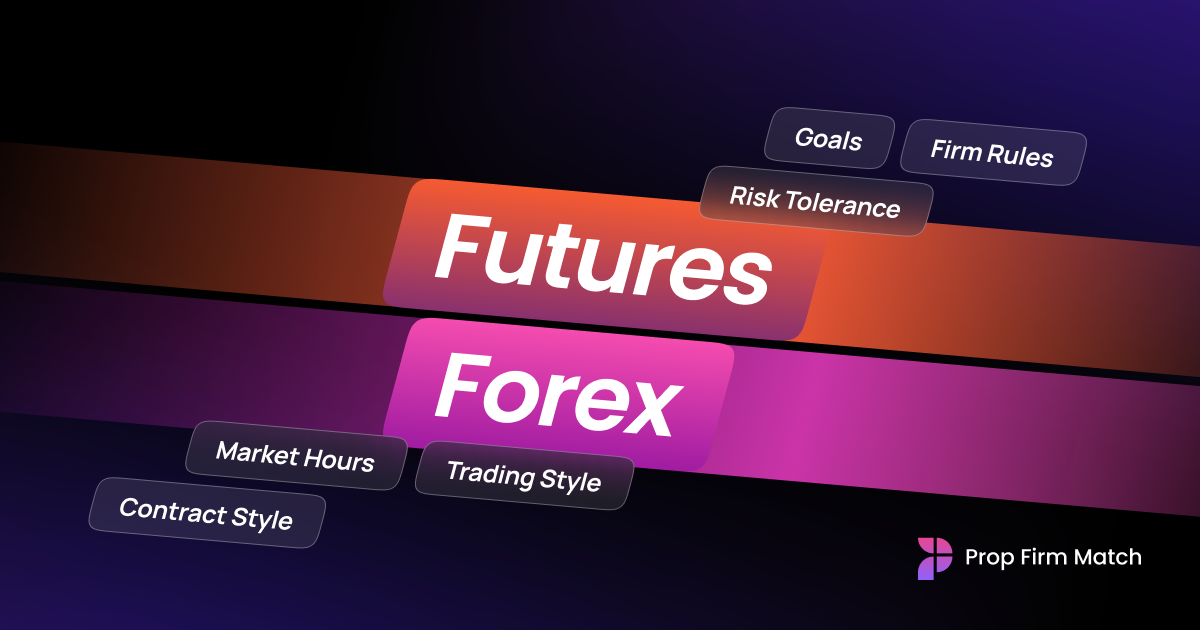
Futures prop firms and forex prop firms can look similar from the outside.
Both may offer funded account programs. Both may use evaluations or challenges. Both may advertise account sizes, profit targets, drawdown rules, payout structures, and platform access.
But the trading experience can be very different.
Futures prop firms are built around futures contracts, contract limits, exchange-traded products, futures platforms, and futures-specific risk rules. Forex prop firms are usually structured around currency pairs, CFDs, lot sizing, leverage, broker-style platforms, and forex or multi-asset trading conditions.
Which model makes more sense depends largely on what the trader already trades.
Someone focused on index, commodity, treasury, or other futures markets may be more comfortable with contract-based sizing. A trader already working with currency pairs, MT4 or MT5, and lot-based risk may find a forex prop firm more familiar.
This article compares futures prop firms and forex prop firms across instruments, position sizing, platforms, account rules, payouts, costs, country availability, and strategy fit.
Before comparing individual programs, it helps to narrow the search to firms that have already gone through a review process.
On Prop Firm Match, listings are not automatic and cannot be purchased. Firms must pass a review process before being approved for inclusion, and rankings are not determined by commercial agreements. Prop Firm Match also uses data-led signals such as trader activity, user feedback, payout-related evidence, and other platform data when informing rankings, comparisons, and trust signals.
A listing is not a guarantee that a firm is risk-free. Nor should it be treated as an endorsement, certification, regulatory approval, or promise of future performance.
What it does provide is a more structured place to begin than random social media recommendations, outdated spreadsheets, or comparisons built mainly around discounts.
Traders who want more detail on how firms are reviewed, ranked, and monitored can read Prop Firm Match's Transparency & Methodology page.
Futures prop trading is built around standardized futures contracts rather than lot-based forex positions.
Depending on the firm and platform, available products can include contracts linked to equity indices, commodities, metals, energy, treasuries, currencies, and other futures markets.
Typical program rules can cover:
An evaluation may begin in a simulated environment. After qualification, the next stage could be a simulated funded account with real payouts or, in some models, part of a progression toward live-funded trading.
The practical shift is in how the trader thinks about risk. Futures trading means dealing with contracts, ticks, exchange sessions, platform connections, and futures-specific drawdown mechanics.
For a deeper explanation, read What Is a Futures Prop Firm?
Forex prop firms generally offer funded account programs focused on currency pairs, CFDs, or a broader mix of broker-style instruments.
Many use challenge models where the trader must reach a profit target while staying within rules covering areas such as:
Platforms commonly associated with this side of the industry include MT4, MT5, cTrader, DXtrade, and TradeLocker, although support varies between firms.
For traders already accustomed to currency pairs, spreads, commissions, and lot-based position sizing, that environment may require less adjustment.
The label can be broader than it sounds, though. Some firms offer forex only. Others include indices, metals, commodities, crypto CFDs, stock CFDs, or additional products.
The asset list therefore deserves attention before the account structure does.
| Category | Futures Prop Firm | Forex Prop Firm |
| Main instruments | Futures contracts | Forex pairs/CFDs |
| Position sizing | Contracts and micros/minis | Lots, mini lots, micro lots |
| Common platforms | NinjaTrader, Tradovate, TradingView, Quantower, Rithmic, TopstepX, and other futures platforms | MT4, MT5, cTrader, DXtrade, TradeLocker, and other broker-style platforms |
| Key risk rules | Contract limits, max loss, trailing or EOD drawdown, daily loss rules | Daily loss, max loss, leverage, lot limits, news and weekend rules |
| Market structure | Futures contracts traded through futures venues and data connections | Broker or CFD-style execution model, depending on the firm |
| Typical fit | Traders focused on futures products, contract-based risk, and futures platforms | Traders focused on currency pairs, CFDs, and lot-based risk |
| U.S. availability | Often a practical starting point for U.S. traders to compare | Can be more restricted for U.S. traders |
| Main thing to check | Drawdown model, contract limits, platform/data setup, payout rules | Daily loss, max loss, spreads, leverage, platform, country access |
The clearest difference is the market itself.
Futures prop firms focus on futures contracts. Depending on the program, that can include:
Availability varies by firm, account type, broker, and platform.
Forex prop firms typically center on currency pairs and may extend into CFD products such as indices, metals, commodities, crypto, or stocks.
Once the instrument changes, so does the risk language.
Futures traders need to understand contract specifications, tick values, exchange sessions, and contract limits. Forex traders work more often with lots, pips, spreads, swaps, leverage, and broker trading conditions.
Someone comfortable trading EUR/USD or GBP/JPY will not automatically be comfortable sizing NQ, ES, CL, or GC. The reverse is equally true. Traders who want to narrow futures firms by the markets they offer can also browse prop firms by asset on Prop Firm Match.
Choose the market first. The funded model comes after that.
The two models also use different sizing systems.
Futures positions are generally expressed in contracts. Depending on the product and account rules, traders may use micro contracts, mini contracts, or other contract sizes.
A futures program may set a maximum contract allowance for each account size. That limit directly affects how much exposure the trader can take.
Forex sizing works differently. Positions are normally expressed in lots, with standard, mini, and micro lot sizes available depending on the instrument, leverage, and program.
Neither method is inherently simpler.
The important question is which one the trader already understands well enough to size consistently.
Before choosing between the two, consider:
A familiar position-sizing model reduces one source of unnecessary complexity.
This is where two programs that look similar on the sales page can behave very differently.
Futures prop firms often place particular emphasis on:
Forex programs commonly focus on:
There is plenty of overlap. The difference is often in the calculation.
One futures program might use a trailing threshold that rises with the account. Another could recalculate its drawdown using end-of-day values. A forex program may use a fixed daily loss calculation based on balance, equity, or both.
Labels such as "trailing," "EOD," or "daily loss" are therefore only a starting point.
Find out:
The important part is how the calculation behaves while the strategy is actually running.
For many traders, platform familiarity can make the choice clearer than another percentage point on a payout split.
Futures programs may support:
Forex programs may offer:
The difference goes beyond chart design.
Platform choice affects order entry, execution workflow, trade management, data, commissions, and strategy tools.
A trader who relies heavily on depth of market, order flow, footprint charts, or futures-specific order entry may naturally prefer the futures ecosystem. Someone with years of MT4 indicators, Expert Advisors, and lot-based workflows may have little reason to abandon that setup.
Useful points to establish include:
An otherwise suitable account can still become difficult to use if every trade has to be executed through an unfamiliar environment.
Both models can advertise attractive profit splits.
That percentage tells only part of the payout story.
With futures programs, conditions may include:
Forex programs can include:
Instead of asking only how much of the profit the trader keeps, ask:
What has to happen before that profit becomes withdrawable?
A 90% split with restrictive payout conditions can operate very differently from the same percentage under a simpler withdrawal structure.
Compare the split alongside payout timing, caps, minimum thresholds, payout methods, and any funded-stage conditions that apply after qualification.
Prop Firm Match firm pages and payout-related comparison pages can provide additional context before an evaluation is purchased.
Headline price is another area where a direct comparison can be misleading.
Futures program costs may include:
Forex program costs may include:
The cheapest evaluation is not always the cheapest route to a funded stage.
A futures account may have a low entry price but introduce data, subscription, or activation costs later. A forex challenge may use a simpler one-off purchase while imposing more ongoing trading cost through spreads, commissions, or swaps.
A better comparison looks at:
Think in terms of total program cost rather than the number displayed most prominently on the checkout page.
Country access can remove firms from the shortlist before account rules even enter the discussion.
This is particularly relevant for U.S.-based traders.
Many forex and CFD-style firms restrict traders from the United States. Others accept them, and policies can depend on the firm, broker relationship, platform, product type, or internal restrictions.
Futures programs are often a more practical starting point for U.S. traders to investigate, but access should never be assumed.
Prop Firm Match provides country-specific pages for:
Check country eligibility before spending time comparing price, account size, or payout structure.
A program that does not accept the trader's country is not part of the real shortlist.
For a deeper U.S.-focused comparison, see Best Funded Trading Firms in the USA.
For many U.S.-based traders, futures programs are a logical place to begin the search.
That is an availability point, not a claim that futures are automatically the better market.
Forex and CFD-style prop access can be more restrictive in the United States. Some firms still accept U.S. traders, but country eligibility needs to be established before their account models are compared.
A practical sequence is:
A U.S. trader who already trades futures may find the decision relatively straightforward. Someone whose strategy is built around forex or CFDs has an extra step: finding firms that support both the market and the trader's location.
Availability comes before brand preference.
Neither category gets an automatic beginner advantage.
What matters more is whether the trader understands the market, sizing system, and account rules well enough to manage risk without improvising.
Futures can be a reasonable starting point for someone who wants to focus on a smaller set of futures contracts, is comfortable thinking in contracts rather than lots, and wants to use Micro futures while learning the mechanics of futures sessions and risk management.
Forex may feel more familiar to a beginner who already trades currency pairs, understands lot sizing, and prefers platforms such as MT4 or MT5. Familiarity with spreads, commissions, swaps, and smaller position-size adjustments can also make the transition into a forex prop firm more straightforward.
For a beginner, familiarity with the market and risk model is usually more valuable than choosing whichever side of the industry currently has the larger promotion.
Both models can work well for intraday strategies.
The deciding factors are usually execution style and the rules surrounding the session.
Futures can be a natural fit for traders focused on index contracts such as ES, NQ, YM, or RTY, particularly if they use order flow, depth-of-market tools, defined exchange sessions, and contract-based risk management.
Forex programs may feel more familiar to traders who concentrate on major or minor currency pairs, trade the London or New York sessions, and already use MT4, MT5, cTrader, indicators, Expert Advisors, or lot-based execution.
Whichever market is used, intraday traders still need to compare:
Firm type alone does not answer the question. The account rules still determine how much room the strategy has to operate.
For more detail, read Funded Accounts for Day Trading: Pros, Cons, and What to Check.
Longer holding periods introduce a different set of considerations.
A swing trader needs to know what happens once a position remains open beyond the intraday session.
With a futures prop firm, the main questions are whether overnight and weekend holding are permitted, how contract and exposure limits work, what happens around news events, and whether the program is designed primarily for intraday trading. Session and data rules can also become more relevant when positions stay open longer.
Forex programs bring a slightly different set of issues. Overnight and weekend permissions still matter, but traders may also need to account for swap fees, floating-loss calculations, news restrictions, and whether open positions can remain in place during a payout review.
Forex may feel more familiar to traders accustomed to holding positions across several sessions. Some futures programs can support longer holding periods too, depending on the account.
The deciding question is simple. Will the rules allow the trade enough time to work as intended?
For more on swing trading, read the Funded Accounts for Swing Trading: Pros, Cons, and Key Rules to Check article.
Once the market is clear, the search becomes much easier.
For futures, traders can begin with the futures prop firm hub. From there, they can explore firms, ratings, review counts, individual firm pages, and filters covering areas such as account size, price, daily drawdown type, max loss type, features, brokers, platforms, and countries.
A smaller shortlist can then be moved to the futures firm comparison tool for side-by-side review.
For forex and CFD-style firms, traders can start with the Prop Firm Match CFD hub. From there, they can explore firm pages, country lists, challenge filters, reviews, payout information, and comparison tools.
A practical workflow looks like this:
Futures deserves a closer look when the trader already works comfortably with:
It can also be a practical route where access to forex or CFD-style programs is more restricted.
The trade-off is that futures have their own learning curve. Contract values, market-data requirements, platform connections, and drawdown mechanics need to be understood before adding prop firm rules on top.
Forex is the more natural route when the existing strategy already revolves around:
Country access remains part of the equation. The firm needs to accept traders from the relevant jurisdiction and support the platform and instruments the strategy requires.
For a trader already fluent in that environment, moving to futures simply because a futures firm is popular would add complexity without necessarily adding an advantage.
Not automatically. Futures programs are generally more relevant to traders who already trade futures contracts and understand contract-based risk. Forex programs are more naturally aligned with traders who focus on currency pairs or CFDs and use lot-based execution.
The underlying trading model is the biggest difference. Futures programs are built around futures contracts, contract limits, futures platforms, and futures-specific drawdown structures. Forex firms generally revolve around currency pairs, CFDs, lot sizing, leverage, and broker-style platforms.
Futures prop firms are often a more practical starting point for U.S. traders to compare because many forex and CFD-style firms restrict U.S. access. Eligibility still needs to be checked for the individual firm.
Usually not in the same sense as a forex prop firm. Futures programs generally focus on futures products. Currency futures can provide exposure to currency markets, but they are not the same instrument as spot forex or forex CFDs.
Most forex prop firms do not offer exchange-traded futures. Some provide CFDs linked to indices, commodities, or other markets, but the exact asset list varies by firm.
Neither is inherently easier. Futures require an understanding of contracts, ticks, sessions, and futures-specific risk rules. Forex requires familiarity with lots, pips, spreads, swaps, leverage, and broker execution. The model a trader already understands will usually be easier.
Both can support day trading. Futures may be more natural for traders focused on index futures, order flow, and contract-based intraday strategies. Forex can fit traders who focus on currency pairs, FX sessions, and lot-based execution.
Forex may feel more familiar to traders accustomed to holding positions across sessions, but some futures programs also support longer holding periods. Overnight, weekend, news, and drawdown rules need to be checked in either model.
No. Profit split needs to be considered alongside payout timing, caps, minimum withdrawals, consistency requirements, drawdown structure, platform costs, and funded-stage conditions.

Hola Prime at Prop Firm Expo London 2026: What Traders Should Know
Hola Prime is one of the few prop firms running both full CFD and futures operations side by side, with five different CFD funding routes built for different trading styles. This guide breaks down how the structure works, what rules matter most, and what traders should understand before speaking to the team at Prop Firm Expo London 2026.
May 19, 2026 • 10 min read

What Is a Funded Trading Account? A Practical Overview
In this guide, we break down what a funded trading account is, how it works, its benefits and risks, and how it compares to trading with your own capital so you can decide if it’s the right path for you.
Jan 21, 2026 • 6 min read
How to Choose a Futures Prop Firm in 2026: Step-by-Step Framework
To choose a futures prop firm, start with your trading style and risk requirements rather than price or account size. This 2026 guide provides a 14-step framework for comparing futures prop firms, covering drawdown types, daily loss limits, contract limits, payout conditions, trading platforms, account costs, and trader reviews. Learn how to use Prop Firm Match filters and comparison tools to shortlist suitable firms, compare their rules side by side, and make a more informed decision before purchasing an evaluation.
Oct 26, 2026 • 15 min read

Reviews & Rankings
News & Insights
Programs & Rewards
200 Loyalty Points Welcome Bonus.
Sign up free to claim points, unlock rewards, save favorite firms, and start earning more through reviews and platform activity.