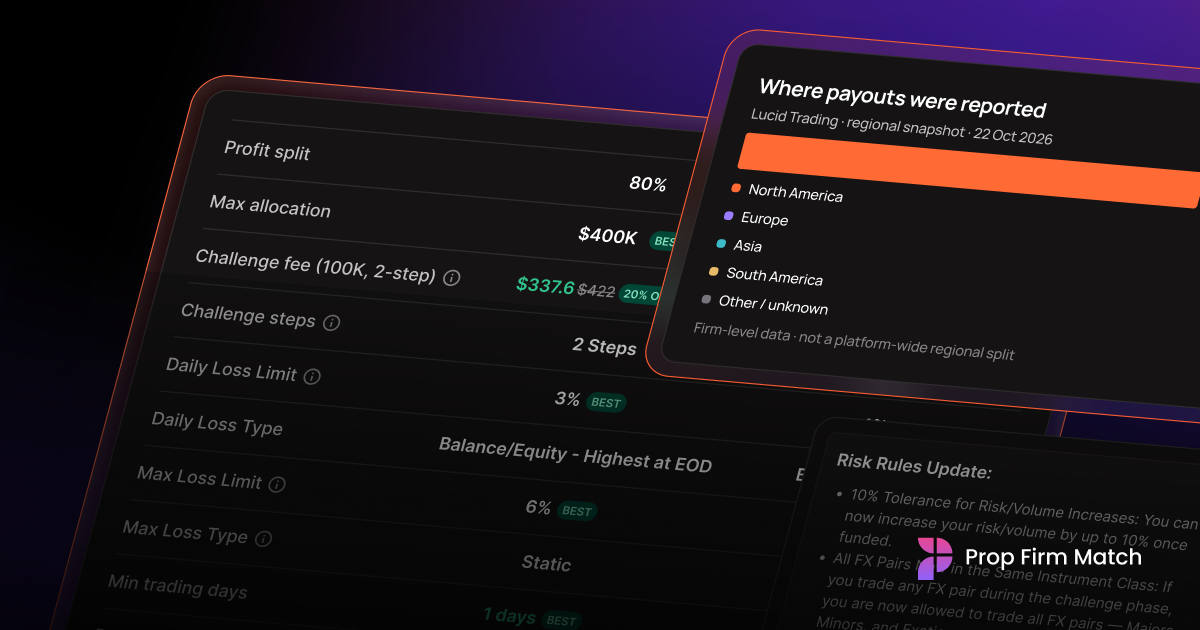
Two futures prop firms can look almost identical until their actual programs are placed side by side.
Both might offer a $50K evaluation. Both might advertise similar profit splits. They may even support the same trading platform.
Then the differences start to show.
One could use end-of-day drawdown while the other uses intraday trailing drawdown. One may impose a daily loss limit while the other leaves more room within the overall drawdown. Profit targets can differ too, as can consistency requirements, payout conditions, minimum trading days, and the rules that apply after qualification.
Comparing the firm name alone will not reveal all of that.
A more useful comparison looks at the firm, the individual program or challenge, and the rules that matter to the trader's strategy.
Prop Firm Match gives traders several ways to do this.
Comparing futures prop firms means looking at how firms, and the individual programs they offer, differ in the areas that can affect trading.
That includes the obvious numbers, such as price and profit targets, but also drawdown behaviour, payout conditions, platforms, trading permissions, and what happens after an evaluation is passed.
More data does not necessarily make the comparison more useful. What matters is whether the differences being shown actually affect the trader's decision.
The real questions are more practical:
A good comparison takes a large market and reduces it to a small number of realistic options.
Not every comparison needs to begin with the same information.
Sometimes the firm itself is the starting point. In other cases, the account rules or one non-negotiable requirement can narrow the search much faster.
It helps to separate those approaches.
Firm-level comparison looks at the firm rather than one particular evaluation.
That makes it useful early in the process.
Areas worth comparing can include:
Once two firms have been selected, the futures firm comparison tool can place them side by side.
Firm-level comparison is mainly a way to build the shortlist.
Once two or three providers look credible, the next question is not really about the brands anymore. It is about the accounts they offer.
That is where program-level comparison becomes more useful.
A single firm can offer several programs that behave very differently.
Comparing only the firms can therefore hide the differences that have the biggest effect on trading.
Two firms might both offer a $50K account while using different:
Prop Firm Match's comparison experience allows traders to move beyond the firm-level view and look at individual program structures.
This becomes especially useful when two firms have already made the shortlist.
At that stage, choosing between the firms matters less than comparing the accounts themselves. A $50K program from one firm may operate very differently from a $50K program at another.
The better fit often becomes obvious only once those rules are placed side by side.
Sometimes there is no reason to start with firm names at all.
A trader may already know the one requirement that cannot be compromised.
That could be:
If one condition is non-negotiable, use it to cut the list first.
A trader who only wants EOD drawdown, for example, does not need to research every futures firm and eliminate the unsuitable ones manually. Applying that requirement at the start can leave a much smaller group worth comparing properly.
Prop Firm Match's filters are useful for exactly that kind of narrowing.
A useful comparison can be built in stages.
Begin with the Prop Firm Match futures Challenges page.
Starting in the futures section keeps unrelated forex, CFD, stock, and crypto programs out of the search.
There is no need to decide anything yet. Browse the firms, open a few profiles, look at the available account structures and platforms, and get a sense of what the market currently offers.
The shortlist comes later.
Before filtering anything, write down the conditions an account has to meet to remain in consideration.
For example:
Those requirements make the first cut much easier.
If Tradovate is essential, a firm that does not support it can come off the list immediately. The same goes for drawdown. A trader who specifically wants an end-of-day model does not need to spend time analysing programs built only around intraday drawdown.
Prop Firm Match allows futures programs to be narrowed through core filters such as:
Additional filtering can include areas such as:
Not every filter needs to be used. Start with the ones tied to the trader’s actual requirements and narrow further only if the list is still too broad.
Once the list is more relevant, sorting can make it easier to work through.
Price may matter most to one trader. Another may want to see the highest-rated firms first, compare review volume, or look at maximum allocation.
The key is to sort a list that already fits the basic requirements. A low-priced program that fails a non-negotiable rule should never have made it this far.
The next job is subtraction.
Three to five firms are much easier to compare than fifteen.
By now, the obvious mismatches should already be gone. What remains is a much smaller group worth investigating properly.
Now the futures firm comparison tool becomes more useful.
Side-by-side comparison can make differences easier to spot than moving repeatedly between firm pages.
Areas to compare can include:
At this point, differences between the firms are usually much easier to spot.
This is where the comparison becomes much more specific.
A firm can look strong overall while the particular account being considered still has a rule that makes it unsuitable.
Compare the specific accounts being considered across areas such as:
This is often where two accounts that appeared similar at first start to look very different.
A comparison page can contain a lot of information, but only some of it changes how the account will actually trade.
The following areas deserve the closest attention.
Two accounts with the same nominal size can offer very different amounts of usable risk.
Common drawdown structures include:
The percentage or dollar amount alone does not tell the whole story.
What matters is how the threshold moves, whether unrealized profit affects it, when it updates, whether it eventually stops trailing, and whether the calculation changes after qualification.
For a broader decision framework, see How to Choose a Futures Prop Firm in 2026.
For the comparison itself, the principle is to compare how the drawdown behaves, not just the number next to it.
A daily loss limit can materially change how a strategy operates.
Two programs may offer similar maximum loss allowances while placing very different restrictions on a single trading day.
Look at whether the rule exists, how it is calculated, when it resets, whether unrealized P&L is included, what happens when the threshold is reached, and whether the funded stage uses the same structure.
The absence of a daily loss limit can be attractive, but that alone does not make one program better than another.
What matters is how the rule fits the trader’s normal risk management and trading frequency.
The headline account balance often gets more attention than the amount the trader is actually allowed to lose.
A $50K account may have only a fraction of that figure available as downside before a breach.
For that reason, compare the account size + maximum loss + drawdown method as one risk structure.
That combination says far more about the practical room in the account than the nominal balance alone.
Profit targets are easy to compare because the number is usually obvious.
The mistake is viewing that number on its own.
A lower target can make the evaluation mathematically easier to complete, but the surrounding rules still determine how accessible that target really is.
Compare it with:
A lower target can look easier on paper while tighter loss rules make the actual path to that target more difficult.
Some futures programs use a one-step evaluation.
Others use different qualification structures or provide routes that reduce or remove the traditional evaluation stage.
The number of steps can affect the total targets, potential cost, time to qualification, and number of rule sets the trader needs to navigate.
Someone looking for the shortest route may prefer a one-step or direct structure.
For someone else, an extra evaluation step may matter less than the rules that apply once the account is funded.
Consistency rules deserve particular attention from traders whose performance comes from a small number of large winning days.
They can apply during evaluation, the funded stage, payout qualification, or a combination of these.
Useful questions include:
Two otherwise similar accounts can produce very different trading experiences once a consistency requirement is added.
A large profit split does not necessarily mean a better payout structure.
Look at the entire withdrawal process:
Instead of asking which firm offers the highest percentage, rather ask when can eligible profit actually be withdrawn, and under what conditions.
Traders can also browse futures prop firms by payout rules and payout options on Prop Firm Match.
Two $50K accounts can allow very different position sizes once contract limits are taken into account.
Platform preference can narrow the field quickly.
Depending on the trader's workflow, relevant platforms may include:
The broker or data connection can matter too.
Price alone becomes less compelling if the account requires the trader to abandon an established execution workflow for a platform they do not know well.
Some strategies depend on features that are not universally allowed.
Relevant permissions can include:
This is one of the clearest reasons to define strategy requirements before comparing headline offers.
An account can look attractive on price, drawdown, and payouts and still be unusable if it blocks a core part of the trading plan.
Rule tables show how the account is supposed to work. Reviews can add context about what traders actually experienced.
Patterns worth looking for include:
One isolated review should not outweigh the program rules.
The useful signal comes from recurring themes across a meaningful amount of feedback.
A highly rated firm can still offer an account that does not fit a particular strategy.
Country restrictions belong near the beginning of the comparison, not the end.
There is little value in analysing drawdown, payouts, and platforms for a firm that does not accept traders from the relevant country.
Availability can also change, so current country eligibility needs to form part of the final account review as well.
The distinction is simple but important.
Both comparisons are useful because they answer different questions.
The firm comparison identifies the firms, while the program comparison identifies the account structure.
A complete decision usually needs both.
Common mistakes include:
The purpose of comparison is not to find the firm with the strongest headline.
It is to remove uncertainty around the rules the trader will actually have to follow.
Start with the requirements that matter most to the strategy and filter out firms that fail them. Once the list is smaller, compare the remaining firms and individual programs side by side.
Important areas include drawdown type, daily loss, maximum loss, profit targets, evaluation steps, consistency requirements, payouts, contract limits, platforms, trading permissions, reviews, and country availability.
Yes. Prop Firm Match provides a futures firm comparison tool for viewing firms side by side.
Yes. Prop Firm Match's comparison experience allows traders to review specific programs across firms and compare account-level areas such as account size, evaluation steps, targets, loss limits, drawdown structure, trading requirements, payouts, and supported features.
Both serve different purposes. Firm comparison helps assess the firm, while program comparison shows the rules of the specific account being considered. A final decision will usually involve both.
Price belongs in the comparison, but usually after rule fit. A cheaper account can offer poor value if its drawdown, payout conditions, platform, or trading permissions conflict with the strategy.
There is no universally best drawdown structure. Static, trailing, end-of-day, and intraday models behave differently. What matters is how the calculation interacts with the trader's normal risk and holding behaviour.
No. Payout frequency, caps, qualifying days, minimum withdrawals, consistency requirements, buffers, payout methods, and funded-stage conditions can be just as important.
Yes, particularly for identifying recurring themes around support, payouts, rule clarity, and platform experience. Reviews work best as context alongside the actual program rules rather than as a replacement for them.
Futures Prop Firm vs Forex Prop Firm: Which Should You Choose?
Futures prop firms generally suit traders who focus on futures contracts and contract-based position sizing, while forex prop firms may be more familiar to traders using currency pairs, CFDs, and lot-based trading. This guide compares futures and forex prop firms across trading instruments, platforms, drawdown rules, evaluation costs, payout conditions, and country availability. Learn the key differences, which model may suit beginners, day traders, and swing traders, and what to consider before choosing a funded trading program.
Nov 2, 2026 • 19 min read
How to Choose a Futures Prop Firm in 2026: Step-by-Step Framework
To choose a futures prop firm, start with your trading style and risk requirements rather than price or account size. This 2026 guide provides a 14-step framework for comparing futures prop firms, covering drawdown types, daily loss limits, contract limits, payout conditions, trading platforms, account costs, and trader reviews. Learn how to use Prop Firm Match filters and comparison tools to shortlist suitable firms, compare their rules side by side, and make a more informed decision before purchasing an evaluation.
Oct 26, 2026 • 15 min read

What Is a Futures Prop Firm? How Funded Futures Trading Works
A futures prop firm gives traders access to rule-based accounts for trading futures contracts, typically through an evaluation process. This guide explains how futures prop firms work, including evaluation requirements, simulated and live funded accounts, static and trailing drawdown, trading costs, and payout conditions. It also compares futures prop firms with traditional futures brokers and forex prop firms, helping traders understand the differences and what to consider before purchasing a futures evaluation.
Oct 19, 2026 • 17 min read

Reviews & Rankings
News & Insights
Programs & Rewards
200 Loyalty Points Welcome Bonus.
Sign up free to claim points, unlock rewards, save favorite firms, and start earning more through reviews and platform activity.