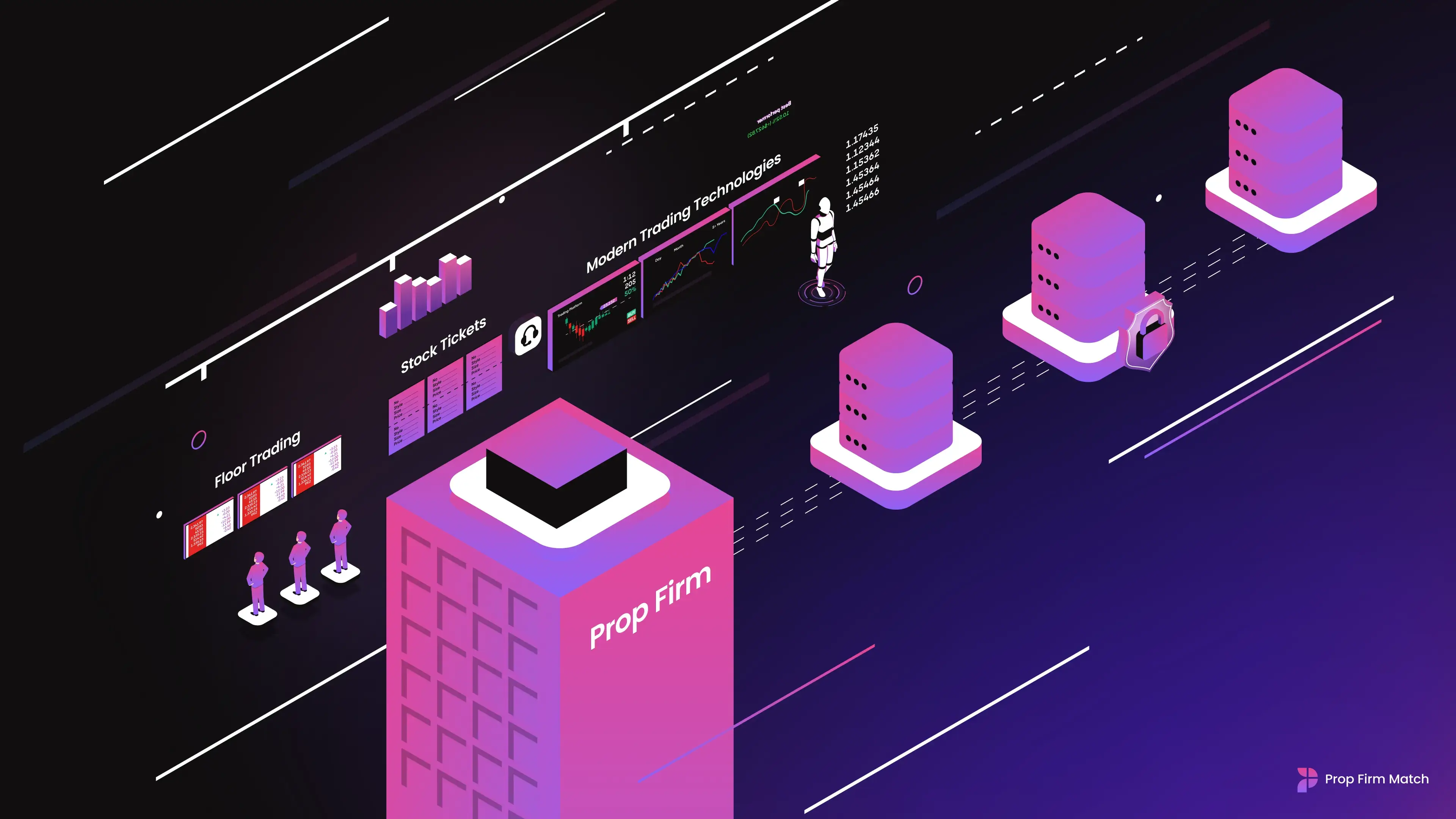
Prop trading firms use their own capital to generate profits in the financial markets. Unlike brokers, they don’t manage client money. Instead, they fund traders who pass structured evaluations that assess performance and risk management.
Technology is reshaping how prop firms work. From faster trade execution to real-time data and automated risk checks, new tools are making the process more transparent and performance-driven. This article explores how these technologies work, what tools are reshaping the space, and how they’re affecting traders and firms alike.
Prop trading refers to firms using internal funds to execute trades in global markets. These firms often offer traders the chance to manage capital after passing a challenge or evaluation process. That process usually includes profit targets, drawdown rules, and consistency checks.
Tech isn’t just a bonus, it’s now central to how prop firms operate. Today’s trading environment demands speed, data accuracy, and automated oversight. Traders rely on platforms that display real-time account metrics, enforce rules automatically, and provide transparent execution feedback.
Prop trading has come a long way from floor trades and stock tickers. Firms today depend on advanced software, algorithmic systems, and AI to execute trades and interpret market data in real time.
Algorithmic Trading
The introduction of algorithmic trading revolutionized the industry. Traders can automate strategies, reduce manual error, and execute trades in milliseconds. Tools like MetaTrader 5 and cTrader are staples for their algo features.
Machine Learning and AI
These technologies spot patterns in massive datasets, helping firms make smarter decisions. Platforms like Alpaca and QuantConnect support AI-driven trading strategies.
High-Frequency Trading (HFT)
HFT uses powerful algorithms and low-latency connections to execute trades in microseconds. Firms like Virtu Financial and Citadel Securities lead in this space.
Advanced data-driven tools are enhancing prop traders’ ability to execute successfully in today’s markets.
Proprietary Trading Platforms
Custom-built platforms connect with evaluation dashboards to enforce rules automatically. Many integrate with MetaTrader 5, cTrader, or TradeLocker.
View prop firms with in-house platforms here.
Advanced Analytics
Tools like TradeStation and NinjaTrader help traders backtest strategies, identify patterns, and track market trends with precision.
Risk Management Systems
Real-time risk management is essential. Software like Rithmic and RiskMetrics helps firms monitor exposure, set stop losses, and avoid big losses.
Machine learning and HFT significantly speed up trade execution. For instance, XTX Markets processes over 120 billion quotes daily.
AI improves decision-making by revealing patterns in historical data. Firms like Two Sigma and Renaissance Technologies use AI to stay ahead.
Risk tools like Bloomberg Terminal provide real-time analytics and monitoring to help firms maintain control in volatile conditions.
Prop firms face strict regulations. RegTech tools like NICE Actimize and AxiomSL help automate compliance and reduce regulatory risk.
These tools are becoming more powerful and accessible. Companies like OpenAI and Google DeepMind are pushing the envelope in predictive financial modeling.
With cryptocurrencies growing, blockchain introduces new secure asset classes and transaction systems. Platforms like Ethereum and Chainalysis are key players.
Cloud providers like AWS and Microsoft Azure enable scalable infrastructure that adapts to spikes in trading activity and data analysis needs.
Technology has redefined prop trading—enhancing speed, efficiency, decision-making, and risk management. Firms and traders now operate with greater precision.
In trading, adaptability is everything. The most successful prop firms are those that evolve with technology, enabling their traders to spot opportunities and manage risk better than the rest.
Prop trading uses firm capital to seek profits. Market makers quote both buy and sell prices, providing liquidity for others.
Strategies vary: algorithms, scalping, swing trading, arbitrage, and trend-following are common depending on trader style and firm guidelines.
Yes, often extensively. Leverage lets traders control larger positions with less capital, but it requires strict risk controls.
For disciplined traders who follow systems and manage risk, yes. It’s a long-term career path—not a shortcut to quick wins.
Keep Reading
Futures Rollover Explained: When to Roll Contracts and What Prop Traders Should Check
Futures rollover can affect liquidity, slippage, chart levels, drawdown room, and prop firm rule compliance. This guide explains when to roll futures contracts, how to track volume and open interest, and what funded traders should check before moving to the next active contract.
Sep 14, 2026 • 23 min read
Best Futures Prop Firms to Compare in 2026
Futures prop traders have more firms, platforms, account types, and payout structures to compare than ever before. This guide compares eight futures prop firms that appeared across multiple Prop Firm Match signals, helping traders evaluate each firm by structure, rules, drawdown type, contract limits, platforms, payouts, and trader activity before choosing an evaluation.
Aug 17, 2026 • 17 min read
Funded Accounts for Swing Trading: Pros, Cons, and Key Rules to Check
Swing trading can work inside a funded account, but only when the firm’s rules support the trader’s holding period, risk model, and trade frequency. This guide explains the pros and cons of funded swing trading, including overnight and weekend holding, drawdown calculations, news risk, swap fees, minimum trading days, payout conditions, and what traders should check before buying an evaluation.
Aug 17, 2026 • 12 min read

Reviews & Rankings
News & Insights
Tools & Resources
Programs & Rewards
200 Loyalty Points Welcome Bonus.
Sign up free to claim points, unlock rewards, save favorite firms, and start earning more through reviews and platform activity.